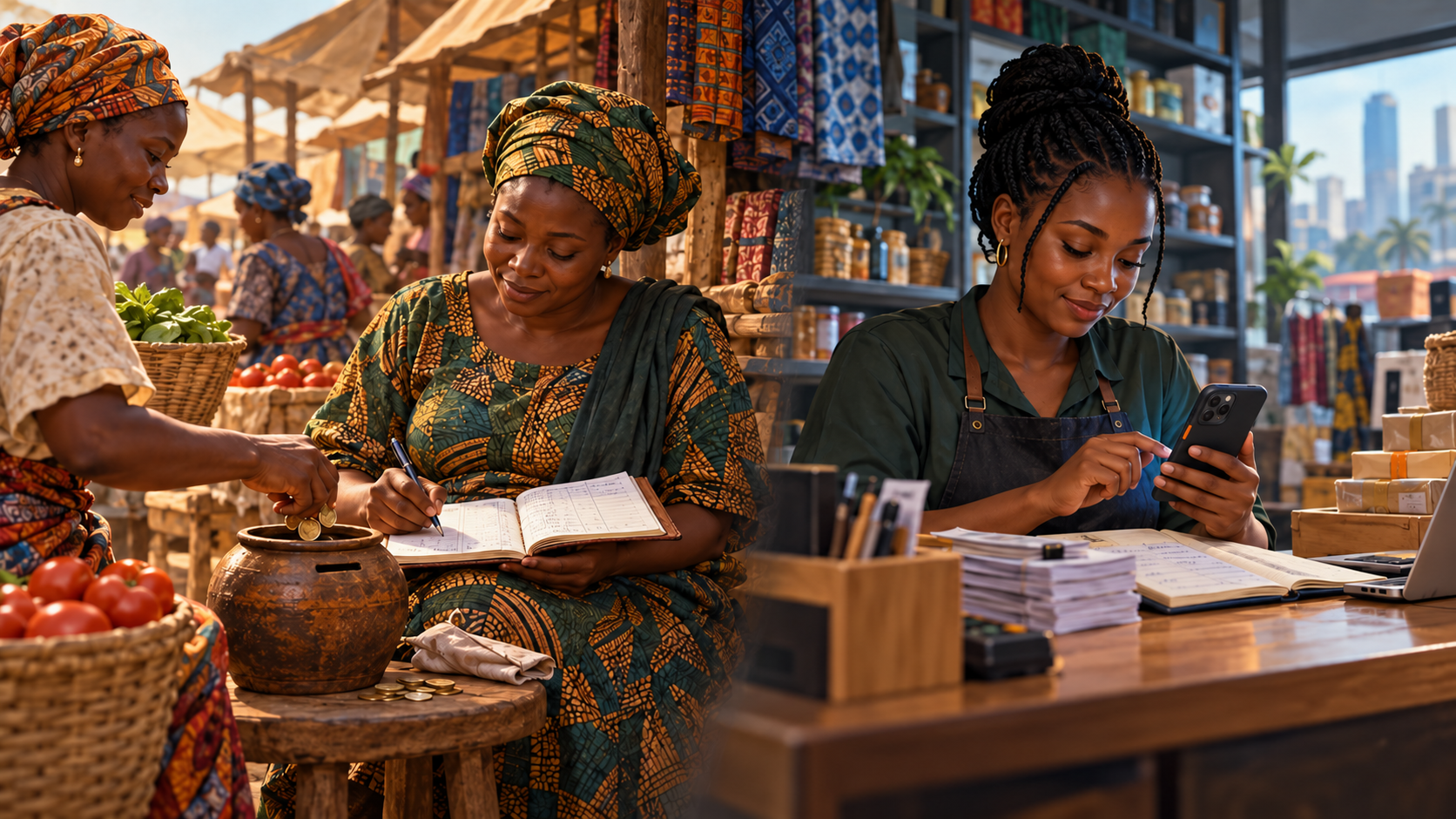
A German logistics company ran a survey of 29,000 online shoppers across 29 countries last year and thought it had found something new. Nigerians buy things through Facebook at a rate of 86%, against a global average of 63%. On Instagram it's 64% versus 48% everywhere else. DHL wrote this up as a trend.
Lagos could have told them that for free. And honestly, we've been doing some version of this for a lot longer than Instagram has existed.
Before WhatsApp, There Was Ajo
Long before anyone coined the term "social commerce," Yoruba communities were running a contributory savings system called esusu, where a group of people each paid into a shared pot on a fixed schedule and took turns collecting the full amount. No bank, no paperwork, no collateral. Just a group of people who trusted each other enough to keep showing up. It's documented as far back as the 18th century, running in the Oyo Empire during the reign of Alaafin Abiodun, and it traveled with Yoruba people across the Atlantic during the slave trade, taking root in Caribbean and American communities under different names.
A close cousin, ajo, worked a little differently. Instead of everyone meeting up, a professional collector called an alajo went door to door, market stall to market stall, collecting contributions daily or weekly and keeping track of who had put in what. That's an entire profession built around moving money through a trust network and holding the running total in one person's memory and notebook.
Strip away the century and that's not so different from a Lagos boutique owner tracking forty customers' orders, part-payments, and "I'll send the balance Friday" promises through a single WhatsApp chat list. Same instinct. Different app.
The Numbers Behind the "Trend"
The DHL figures above aren't the only ones. WhatsApp is installed on 95% of the smartphones surveyed in Nigeria, according to the Orange Group and KPMG Nigeria Smartphone Study 2025, ahead of Facebook Messenger at 32% and Telegram at 27%. Meta's own 2026 "Nigeria's Digital Economy" report, carried out with the research firm Public First, puts a real number on what that actually does for the economy. Fourteen million Nigerian small businesses used Meta's apps in 2025, contributing an estimated $2 billion to the country's GDP, with $640 million of that coming from productivity gains tied specifically to instant messaging. In the same report, 81% of the businesses surveyed said Facebook, Instagram, and WhatsApp had helped them reach customers outside their immediate area.
A separate pan-African survey by Sagaci Research, covering 28 countries, found Nigeria has the highest social commerce penetration on the continent at 69%, ahead of Zimbabwe, Kenya, and Zambia.
None of that reads like a country playing catch-up. It reads like a country that was already fluent in trust-based, relationship-first trading long before the infrastructure to do it over the internet existed, and simply picked up the phone the moment it could.
Where the Old System Starts to Strain
If you're running a business this way right now, the part that actually matters is what happens next. The alajo system worked because one person held the whole ledger in their head and their notebook, and that was fine at the scale it operated at. A WhatsApp or Instagram DM list works the same way, one person holding every order, every "sent the money" claim, every pending delivery, in their head and their chat history. It's genuinely a good system. It's why response speed and trust matter so much more to Nigerian buyers than a polished storefront does.
It also has exactly the failure point the old alajo system had. It depends entirely on one person's memory and attention. Lose the phone, hire a second staff member who doesn't have the same context, or just get busy enough that messages start slipping, and the system that got the business this far starts quietly dropping things. Not because DMs are primitive. Because no version of this was ever built to hold more than one person's working memory.
That's the gap between "a system that works" and "a system that keeps working once the business grows," and it's a solvable one without throwing away WhatsApp or Instagram at all. A proper order log behind the DMs, automatic reminders instead of relied-upon memory, one shared record instead of one person's chat history, that's a smaller build than most people assume, and it tends to pay for itself fast.
If any of that sounds like your shop right now, get a free project estimate and we'll walk through what the simplest fix actually looks like for how you run things today.